Thursday, September 18, 2014

Friday, July 11, 2014
Problem Solved
1950's Silvestri ribbon pattern iron chairs designed by Mario Tempestrini.
Unable to find a material like the original, I used unlaced Danish cord to restore these to the original weave pattern. (See previous post on Material I.D) Since the old and new materials were a different diameter, a calculation had to be made for the appropriate # of strands to achieve the pattern.
Very generously, the owner offered my wife and I the opportunity to sit on the chairs and visit for a couple days
 during an eastern NC vacation. Very pleasant way to enjoy your work, I might say.
They are very comfortable.
Unable to find a material like the original, I used unlaced Danish cord to restore these to the original weave pattern. (See previous post on Material I.D) Since the old and new materials were a different diameter, a calculation had to be made for the appropriate # of strands to achieve the pattern.
Very generously, the owner offered my wife and I the opportunity to sit on the chairs and visit for a couple days
They are very comfortable.
Sunday, April 13, 2014
Material I.D.


2-ply, each twisted. Full diameter=.1"
Tempestrini chairs from 50's or 60's. Wrought iron.
Any thoughts are appreciated.
Friday, April 4, 2014
Tool Belt for Efficient Rushing

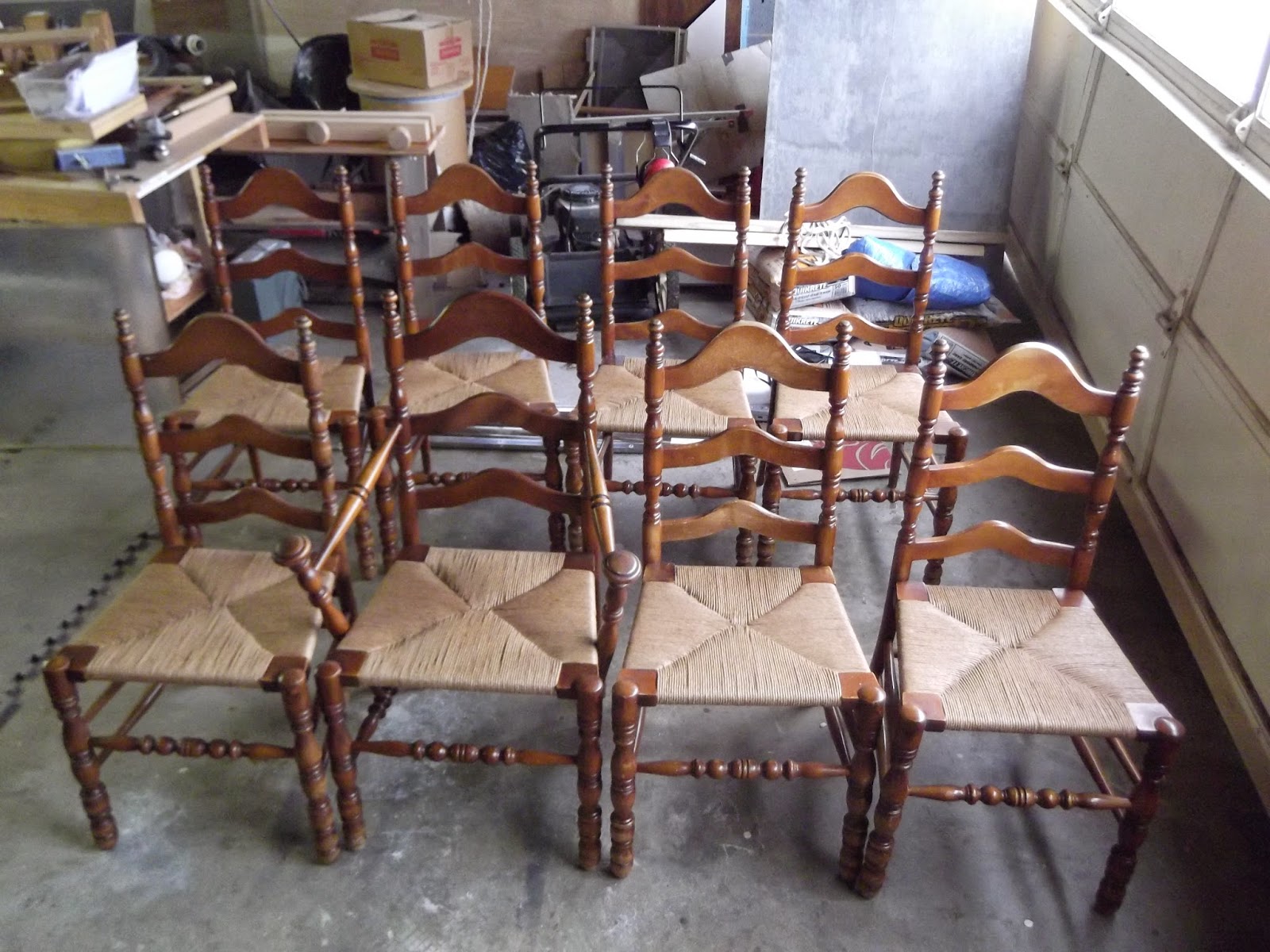
8 Maple dining chairs with a twist.
 |
| Sharp oak edges on seat frames are like a knife over the years. Inadequate stuffing allows the rush to work over that knife edge. |
 |
| Here is the TWIST. Extra rung under the sides of the seats prohibited reweaving on the chair. Wood plugs over the screws must be removed and the seats taken to a frame to reweave. |
 |
| Frame built to clamp into my weaving bench. |
 |
| Some minor regluing. All 8 chairs had loose front rungs. |

Saturday, January 11, 2014
"Antiquing" Gold Fiber Rush
Small black side chair with painted detail. Gold striping and painted back slat. Replacing a broken fiber rush seat that was very dark to black. New seat is 4/32" gold fiber rush. shellacked with Garnet flakes in a 3lb. cut with black dye to achieve the dark antique tone.
My best fiber rush weave to date. Patience and attention to the square corners pays off.


My best fiber rush weave to date. Patience and attention to the square corners pays off.
Wednesday, November 13, 2013
Rung Replacement


Buy an oak dowel of the proper diameter or fabricate a piece of oak to match, then as pictured:
1-Cut the replacement piece to length.
2-hand chisel the tenons and split the ends with a fine saw cut
3-Dry fit(re-measure against the other side just in case)
4-Glue up and clamp both rungs
After 24 hrs., re-weave.
Sunday, September 29, 2013

Sunday, August 11, 2013
Hickory Bark Seats

Very satisfying to accomplish this. Lots to learn as always. Sort of like neurosurgery -- "see one, do one, teach one".
Tuesday, July 16, 2013
Seat Bottom Question??


Anyone seen this chair design and has any other ideas?
Tuesday, May 21, 2013
Potholders or chairseats from LOOPS


This is one of two "muleback" chairs which the customer remembers being on the grandparents' front porch many years ago. Both are quite sturdy and sound structurally. The seats are woven from manufactured cloth loops, which I remember weaving on a small, steel loom to make potholders as a kid with rheumatic fever looking for something to occupy the long hours of seclusion. The loops in this case were doubled and joined to form a weaver, and a simple basket weave was accomplished, which has endured quite a few years. Upholstery fabric was sewn on to complete the seats.
After exploring several options, the customer has decided to have the seats rewoven in 5/8" reed, herringbone.
Friday, January 11, 2013
Twine woven Child's chair?
Here is a twine-type weaving material from a set of children's chairs, quite old. This was woven in a 4x4 strand basket weave top and bottom. Looks to me like bailing twine from the farm. Any other ideas?
 Dimensionally, it is 3/16 - 1/4". I'll be checking the farm supply stores for something close. It seems a tad heavy for what I am remembering of bailing twine from my farm days as a kid.

Thursday, December 20, 2012
Delicate Ladderback for Rush.


Double Rung Footstool


This is a 15" seat, and 5/8" reed, varnished with semi-gloss. No stain was desired by the customer.
I am happy with the result.
Thursday, August 2, 2012
Child's Arm Chair with handwoven Cane Seat
What a handsome little handmade, handcarved child's chair with broken cane seat. The posts were turned and then carved. The arms and back ore carved as well.
On close inspection, the # of holes in the back rail is uneven and hence has a center hole, but the front rail has an even # of holes and hence has 2 center holes. The seat was originally woven on a slant because the weaver had to choose a center hole in the front. Likewise, 1 side rail has 1 more hole than it's opposite side. Also. the corner post locations for 2 diagonals have no holes and these strands were glued in place.


 The holes for the caning were drilled diagonally into the inside of the frame so the caning would be concealed underneath the seat.
The binder cane was nailed to the 4 corner posts,
Other than that, it was a straightforward caning project!
On close inspection, the # of holes in the back rail is uneven and hence has a center hole, but the front rail has an even # of holes and hence has 2 center holes. The seat was originally woven on a slant because the weaver had to choose a center hole in the front. Likewise, 1 side rail has 1 more hole than it's opposite side. Also. the corner post locations for 2 diagonals have no holes and these strands were glued in place.


The binder cane was nailed to the 4 corner posts,
Other than that, it was a straightforward caning project!


Subscribe to:
Posts (Atom)